
Dr. Jody Wayne Blanchard examines how institutions can expand technological capability without surrendering accountability, ethical judgment, or public trust
FLORIDA — As artificial intelligence transforms how organizations analyze information, make decisions, and manage risk, a critical question remains: Who is ultimately responsible when technology influences consequential decisions?
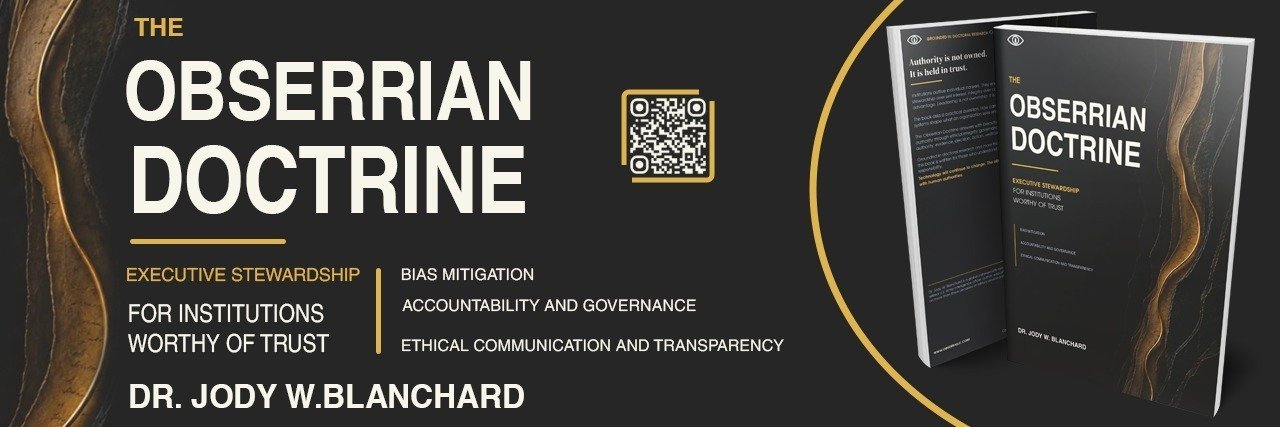
In The Obserrian Doctrine: Executive Stewardship for Institutions Worthy of Trust, Dr. Jody Wayne Blanchard presents a practical, human-centered framework for executives, boards, technology leaders, security professionals, and policymakers navigating that question. Rather than focusing primarily on AI tools, Blanchard examines the responsibilities of the people and institutions that deploy them—and argues that technological sophistication must be matched by equally mature systems of governance and accountability.
Central to the book is the concept of Executive Stewardship: the principle that institutional authority is not owned by leaders but temporarily entrusted to them. Blanchard also explores what he calls the Governance Gap, the widening distance between rapidly expanding organizational capabilities and the governance structures necessary to keep those capabilities ethically controlled, accountable, and worthy of public trust.
The book is grounded in Blanchard’s original doctoral research examining how senior leaders perceive the ethical use of artificial intelligence in organizational policy development. His qualitative study included fifteen senior leaders from three large medical-technology organizations, approximately seventeen hours of interviews, and more than 230 pages of transcripts. The research identified three major themes: bias mitigation, accountability and governance, and ethical communication and transparency.
From that foundation, The Obserrian Doctrine addresses meaningful human oversight, evidence-centered governance, cybersecurity, compliance, organizational risk, ethical leadership, and the need for traceable information that allows leaders to distinguish assumptions from reality. The book is intended for CEOs, board directors, CIOs, CISOs, risk and compliance executives, healthcare and technology leaders, public-sector officials, AI-governance professionals, academics, and others responsible for institutional decision-making.
Blanchard brings extensive experience to the subject. A two-time Fortune 500 Chief Information Security Officer and retired U.S. Army intelligence officer with 21 years of service, he holds a Ph.D. in Organizational Leadership and currently works with boards and executive teams on cybersecurity, risk, governance, and decision-making.
Ultimately, The Obserrian Doctrine delivers a clear message for the intelligent age: technology may analyze, predict, and recommend, but responsibility remains human.